£119.99
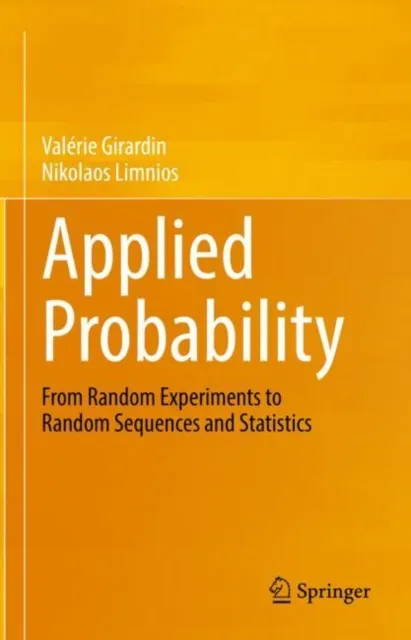
Applied Probability

Applied Probability presents a unique blend of theory and applications, with special emphasis on mathematical modeling, computational techniques, and examples from the biological sciences. Chapter 1 reviews elementary probability and provides a brief survey of relevant results from measure theory. Chapter 2 is an extended essay on calculating expectations. Chapter 3 deals with probabilistic applications of convexity, inequalities, and optimization theory. Chapters 4 and 5 touch on combinatorics and combinatorial optimization. Chapters 6 through 11 present core material on stochastic processes.
If supplemented with appropriate sections from Chapters 1 and 2, there is sufficient material for a traditional semester-long course in stochastic processes covering the basics of Poisson processes, Markov chains, branching processes, martingales, and diffusion processes. This third edition includes new topics and many worked exercises. The new chapter on entropy stresses Shannon entropy and its mathematical applications. New sections in existing chapters explain the Chinese restaurant problem, the infinite alleles model, saddlepoint approximations, and recurrence relations. The extensive list of new problems pursues topics such as random graph theory omitted in the previous editions. Computational probability receives even greater emphasis than earlier. Some of the solved problems are coding exercises, and Julia code is provided.
Mathematical scientists from a variety of backgrounds will find Applied Probability appealing as a reference. This updated edition can serve as a textbook for graduate students in applied mathematics, biostatistics, computational biology, computer science, physics, and statistics. Readers should have a working knowledge of multivariate calculus, linear algebra, ordinary differential equations, and elementary probability theory.