£155.00
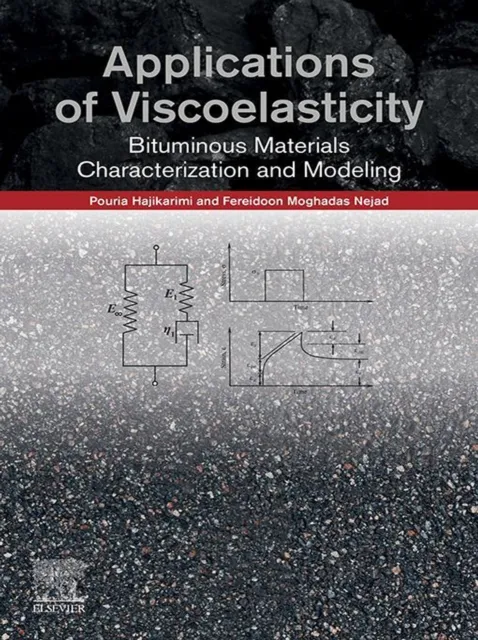
Applications of Viscoelasticity
Bituminous Materials Characterization and Modeling

Applications of Viscoelasticity: Bituminous Materials Characterization and Modeling
Starts with an introduction to the theory of viscoelasticity, emphasizing its importance to various applications in material characterization and modeling. It next looks at constitutive viscoelastic functions, outlines basic equations for different loading conditions, and introduces the Boltzmann superposition principle, relaxation modulus, and creep compliance.
Mechanical models, including integer-order and fractional-order are studied next, featuring real experimentation data alongside the benefits and drawbacks of using each model in various real-world scenarios. The book then covers the correspondence principle, followed by time–temperature superposition, featuring a simple procedure to construct a real master curve and challenges that might be encountered.
The concluding chapters cover the Hopkins and Hamming, Park and Kim, and General Power law methods for interconversion of constitutive viscoelastic functions, applications of viscoelasticity for experimental tests, and incremental form of viscoelastic relations for numerical modeling. The book also includes supplementary codes that users can duplicate and use in their own work.
Takes an applied approach to material viscoelasticity, explaining complicated viscoelastic equations and principles
Presents examples of those equations and principles being applied to common problems in real-world settings
Covers constitutive viscoelastic functions, including relaxation modulus and creep compliance
Outlines the construction of a master curve of viscoelastic material considering time–temperature superposition
Couples the correspondence principle with common viscoelastic experiments, such as three-point bending beam, axial and torsional bar, and dynamic shear rheometer
Provides supplementary codes