£129.50
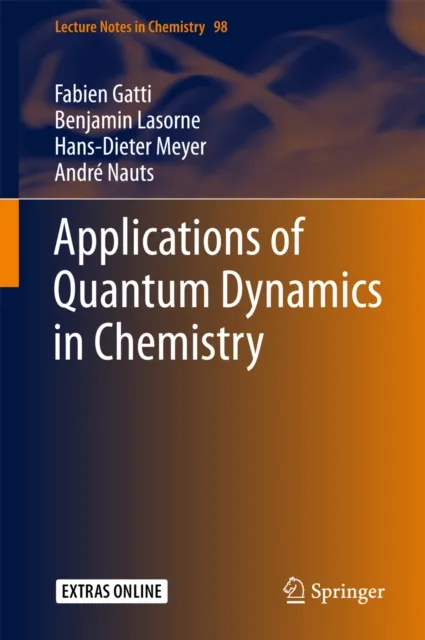
Applications of Quantum Dynamics in Chemistry

Introduction
This book explains the usage and application of Molecular Quantum Dynamics, the methodology where both the electrons and the nuclei in a molecule are treated with quantum mechanical calculations. This volume of Lecture Notes in Chemistry addresses graduate students and postdocs in the field of theoretical chemistry, as well as postgraduate students, researchers and teachers from neighboring fields, such as quantum physics, biochemistry, biophysics, or anyone else who is interested in this rising method in theoretical chemistry, and who wants to gain experience in the opportunities it can offer. It can also be useful for teachers interested in illustrative examples of time-dependent quantum mechanics as animations of realistic wave packets have been designed to assist in visualization.
Application and Examples
Assuming a basic knowledge about quantum mechanics, the authors link their explanations to recent experimental investigations where Molecular Quantum Dynamics proved successful and necessary for the understanding of the experimental results. Examples including reactive scattering, photochemistry, tunneling, femto- and attosecond chemistry and spectroscopy, cold chemistry or crossed-beam experiments illustrate the power of the method. The book restricts complicated formalism to the necessary and in a self-contained and clearly explained way, offering the reader an introduction to, and instructions for, practical exercises. Continuative explanation and math are optionally supplemented for the interested reader.
Practical Use
The reader learns how to apply example simulations with the MCTDH program package (Multi Configuration Time Dependent Hartree calculations). Readers can thus obtain the tools to run their own simulations and apply them to their problems. Selected scripts and program code from the examples are made available as supplementary material.
Conclusion
This book bridges the gap between the existing textbooks on fundamental theoretical chemistry and research monographs focusing on sophisticated applications. It is a must-read for everyone who wants to gain a sound understanding of Molecular Quantum Dynamics simulations and to obtain basic experience in running their own simulations.