£64.99
Analysis of the Gravity Field
Direct and Inverse Problems

Overview
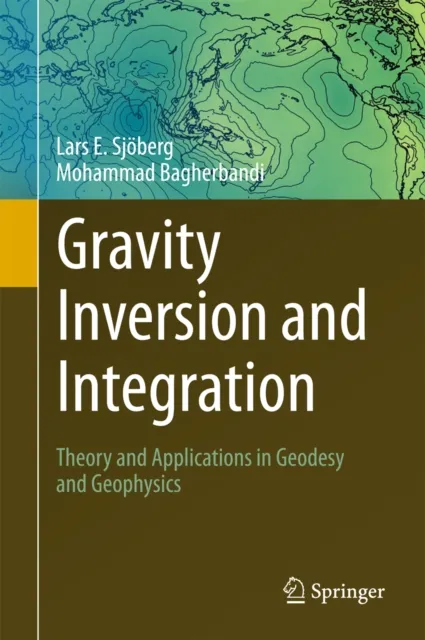
This textbook presents a comprehensive treatment of the theory and implementation of inverse methods in the analysis and interpretation of Earth’s gravity field. By restricting their consideration to a local rather than global level, the authors focus on the use of observations and data that are more sensitive to local mass anomalies. All necessary theoretical aspects are reformulated in terms of a Euclidean framework so that less complex tools from mathematical analysis can be utilized.
Content Structure
Divided into three parts, the text begins with a review of basic mathematical properties of gravitation, computing gravity from mass distributions, and relevant methods from Fourier analysis. In the second part of the text, the Earth’s gravity field and its properties are introduced, and the preprocessing and processing of gravity data are explored. Finally, elementary inverse theory is discussed, after which the general inversion problem is considered via application of both the Tikhonov deterministic approach and a stochastic MCMC model. Throughout, examples and exercises are provided to both clarify material and to illustrate real-word applications for readers.
Audience and Approach
Analysis of the Gravity Field: Direct and Inverse Problems is carefully written to be accessible to both mathematicians and geophysicists without sacrificing mathematical rigor. Readers should have a familiarity with the basics of mathematical analysis, as well as some knowledge of statistics and probability theory. Detailed proofs of more advanced results are relegated to appendices so that readers can concentrate on solution algorithms.