£89.00
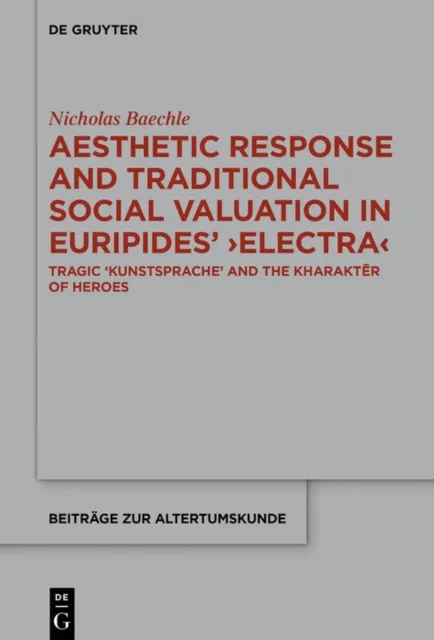
Aesthetic Response and Traditional Social Valuation in Euripides' Electra
Tragic ›Kunstsprache‹ and the ›kharaktēr‹ of Heroes

Introduction to Euripides’ Electra
Euripides’ Electra opened up for its audience an opportunity to become self-aware as to the appeal of tragic Kunstsprache: it both reflected and sustained traditional, aristocratically-inflected assumptions about the continuity of appearance and substance, even in a radical democracy. A complex analogy between social and aesthetic valuation is played out and brought to light.
Characterization of Orestes
The characterization of Orestes early in the play demonstrates how social appearances made clear the identity of well-born, and how they were still assumed to indicate superior virtue and agency.
Aesthetic and Thematic Sequence
On the aesthetic side of the analogy, one of the functions of tragic diction, as an essential indication of heroic character and agency, comes into view in a dramatic and thematic sequence that begins with Achilles ode and ends with the planning of the murders. Serious doubts are created as to whether Orestes will realize the assumed potential inherent in his heroic genealogy and, at the same time, as to whether the components of his character as an aesthetic construct are congruent with such qualities and agency.
Complex Analogy and Reflection
Both sides of this complex analogy are thus problematized, and, at a metapoetic level, its nature and bases are exposed for reflection.