£27.99
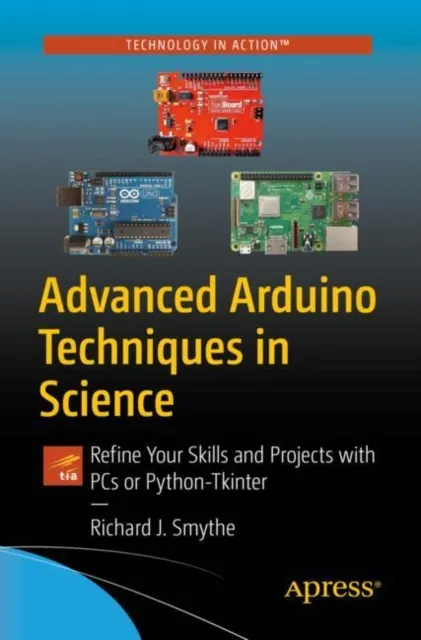
Advanced Arduino Techniques in Science
Refine Your Skills and Projects with PCs or Python-Tkinter

Getting Started
If you’re already a comfortable programmer, familiar with your single board computer and microcontroller, and are ready to refine your projects, then let’s get started! This book covers advanced methods and techniques for creating, implementing, monitoring and controlling your experiments and projects with your Raspberry Pi and Arduino. Projects will use Python and the Tkinter GUI and will also cover software development for adding real time data display to the Raspberry Pi.
Frequency and Measurement
You''ll review concepts of frequency occurring in nature and the techniques used to measure the frequency of electrically varying signal voltages. You''ll also study procedures for safe design, implementation and operation of experimental measurement systems operating at high heats and high temperatures. Throughout the book you''ll look at sources and types of errors, and best practices for minimizing and reducing them.
Environmental Challenges and Techniques
Often times there are simple environmental issues hindering what would seem to be simple projects: high temperatures, controlling the power for elevated temperature with the proportional integral and derivative (PID) algorithm, and the limitations imposed by eight bit code, the influence of noise and errors in measured data, and many more. Advanced Arduino Techniques in Science provides the best tools to move past those restrictions.
What You’ll Learn
- Implement an experimental control system and graphical data display for the Raspberry Pi and Arduino
- Manage experimental control with PID algorithm implementation, tuning and limitations imposed by eight bit digital signals
- Build an analytical front end
- Examine data smoothing capability of the Kalman filter
- Explore available methods for measuring both high and low frequency values in electronic signals
Who This Book Is For
Educators, researchers, students, makers, citizen scientists, or hobbyists can all extend their measuring capability or improve upon the quality of their collected data. The book is directed to those with intermediate skills in programming and those who are comfortable with Python programming and Arduino C.