£4.89
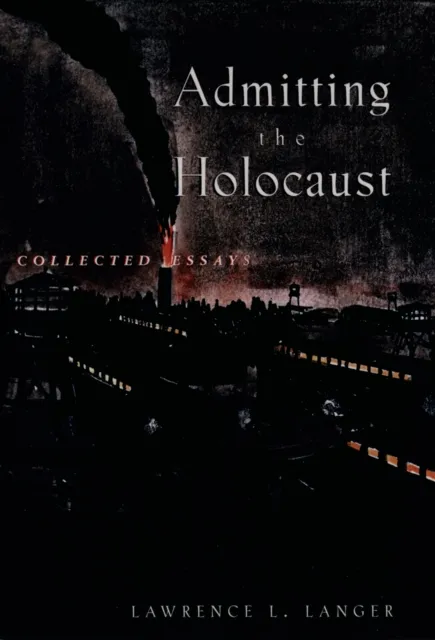
Admitting the Holocaust
Collected Essays

In the face of the Holocaust
writes Lawrence L. Langer, our age clings to the stable relics of faded eras, as if ideas like natural innocence, innate dignity, the inviolable spirit, and the triumph of art over reality were immured in some kind of immortal shrine, immune to the ravages of history and time. But these ideas have been ravaged, and in Admitting the Holocaust. Langer presents a series of essays that represent his effort, over nearly a decade, to wrestle with this rupture in human values--and to see the Holocaust as it really was. His vision is necessarily dark, but he does not see the Holocaust as a warrant for futility, or as a witness to the death of hope. It is a summons to reconsider our values and rethink what it means to be a human being.
Range of Issues Covered
These penetrating and often gripping essays cover a wide range of issues, from the Holocaust's relation to time and memory, to its portrayal in literature, to its use and abuse by culture, to its role in reshaping our sense of history's legacy. In many, Langer examines the ways in which accounts of the Holocaust--in history, literature, film, and theology--have extended, and sometimes limited, our insight into an event that is often said to defy understanding itself.
Notable Writers and Literary Treatments
He singles out Cynthia Ozick as one of the few American writers who can meet the challenge of imagining mass murder without flinching and who can distinguish between myth and truth. On the other hand, he finds Bernard Malamud's literary treatment of the Holocaust never entirely successful (it seems to have been a threat to Malamud's vision of man's basic dignity) and he argues that William Styron's portrayal of the commandant of Auschwitz in Sophie’s Choice pushed Nazi violence to the periphery of the novel, where it disturbed neither the author nor his readers.
Language and Confrontation
He is especially acute in his discussion of the language used to describe the Holocaust, arguing that much of it is used to console rather than to confront. He notes that when we speak of the survivor instead of the victim, of martyrdom instead of murder, regard being gassed as dying with dignity, or evoke the redemptive rather than grievous power of memory, we draw on an arsenal of words that tends to build verbal fences between what we are mentally willing--or able--to face and the harrowing reality of the camps and ghettos.
Hope and Testimony
A respected Holocaust scholar and author of Holocaust Testimonies: The Ruins of Memory, winner of the 1991 National Book Critics Circle Award for criticism, Langer offers a view of this catastrophe that is candid and disturbing, and yet hopeful in its belief that the testimony of witnesses--in diaries, journals, memoirs, and on videotape--and the unflinching imagination of literary artists can still offer us access to one of the darkest episodes in the twentieth century.