£57.99
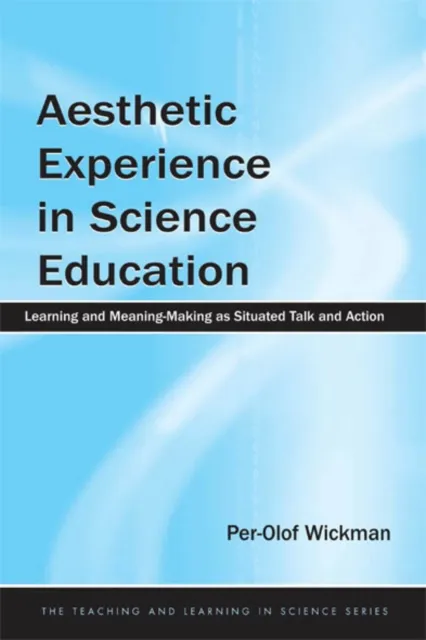
Aesthetic Experience in Science Education
Learning and Meaning-Making as Situated Talk and Action

Introduction
This book examines the role of aesthetic experience in learning science and in science education from the perspective of knowledge as action and language use. The theoretical underpinnings are based on the writings of John Dewey and Ludwig Wittgenstein. In their spirit aesthetics is examined as it appears in the lives of people and how it relates to the activities in which they are involved.
Centered around an empirical analysis of how students and their teachers use aesthetic language and acts during laboratory and field work, the book demonstrates that aesthetics is something that is constantly talked about in science class and that these aesthetic experiences are intimately involved in learning science. These empirical findings are related to current debates about the relation between aesthetics and science, and about motivation, participation, learning and socio-cultural issues in science education. This book features:
- an empirical demonstration of the importance and specific roles of aesthetic experiences in learning science;
- a novel contribution to the current debate on how to understand motivation, participation and learning;
- a new methodology of studying learning in action.
Part I: Theoretical Concepts
Part I sketches out the theoretical concepts of Wickman’s practical epistemology analysis of the fundamental role of aesthetics in science and science education.
Part II: Aesthetic Judgments in Practice
Part II develops these concepts through an analysis of the use of aesthetic judgments when students and teachers are talking in university science classes.
Part III: Implications for Teaching and Learning
Part III sums up the general implications of the theoretical underpinnings and empirical findings for teaching and learning science. Here Wickman expands the findings of his study beyond the university setting to K-8 school science, and explicates what it would mean to make science education more aesthetically meaningful.
Wickman’s conclusions deal to a large extent with aesthetic experience as individual transformation and with people’s prospects for participation in an activity such as science education. These conclusions have significance beyond science teaching and learning that should be of concern to educators generally. This book is intended for educational researchers, graduate students, and teacher educators in science education internationally, as well as those interested in aesthetics, philosophy of education, discourse analysis, socio-cultural issues, motivation, learning and meaning-making more generally.